
The $5 Trillion Wealth Shift; How China Is Quietly Challenging Dollar?
While much of the world remained distracted by holiday shopping, sports headlines, and domestic political debates, a historic shift was unfolding beneath the surface of the global financial system. Without dramatic announcements or headline-grabbing speeches, China initiated a sequence of moves that could reshape the future of money itself.
At the center of this transformation lies a staggering figure: $5 trillion.
This is not just capital moving from one asset class to another. It represents a systemic reallocation of wealth, influence, and financial power—away from the US-dollar-centric system that has dominated global trade for decades.
Most people will not notice this change immediately. But its effects will eventually reach everyone—through inflation, interest rates, commodity prices, and even the value of personal savings.
The Dollar’s Long Reign as Global King; The $5 Trillion Wealth Shift
For nearly a century, the US dollar has served as the backbone of the global economy. It has been:
- The primary reserve currency
- The default unit for international trade
- The foundation of global debt markets
- The anchor for commodities like oil, gas, and metals
Countries across the world—from India to Brazil—have relied on dollar reserves to stabilize their economies. The system worked because of two things: trust and necessity.
Trust in America’s institutions.
Necessity because there was no real alternative.
But history teaches a hard lesson: no financial empire lasts forever.
China’s Quiet Policy Break in Late 2025;The $5 Trillion Wealth Shift
In December 2025, while Western financial markets were closed for the holidays, China made its most dramatic monetary shift in over a decade.
For the first time in 14 years, Beijing abandoned its conservative stance and introduced targeted liquidity mechanisms designed to control where money flows inside the economy.
Two key tools stood out:
- Securities stabilization facilities
- Insurance-linked liquidity swaps
Rather than flooding the entire economy with cheap money, China began surgically directing capital into strategic sectors—locking wealth inside its borders before global markets could react.
This wasn’t stimulus.
It was financial engineering.
Locking In $5 Trillion: Ending Capital Flight
Alongside these tools, China tightened restrictions on capital outflows. Annual limits were enforced more aggressively, effectively halting the steady movement of Chinese wealth into foreign assets.
The result?
An estimated $5 trillion that would have flowed into dollar-based markets is now circulating inside China.
That capital fuels domestic investment, strengthens balance sheets, and reduces reliance on foreign currencies—particularly the US dollar.
The Digital Yuan: Bypassing the Dollar System; The $5 Trillion Wealth Shift
At the core of China’s strategy is the digital yuan (e-CNY).
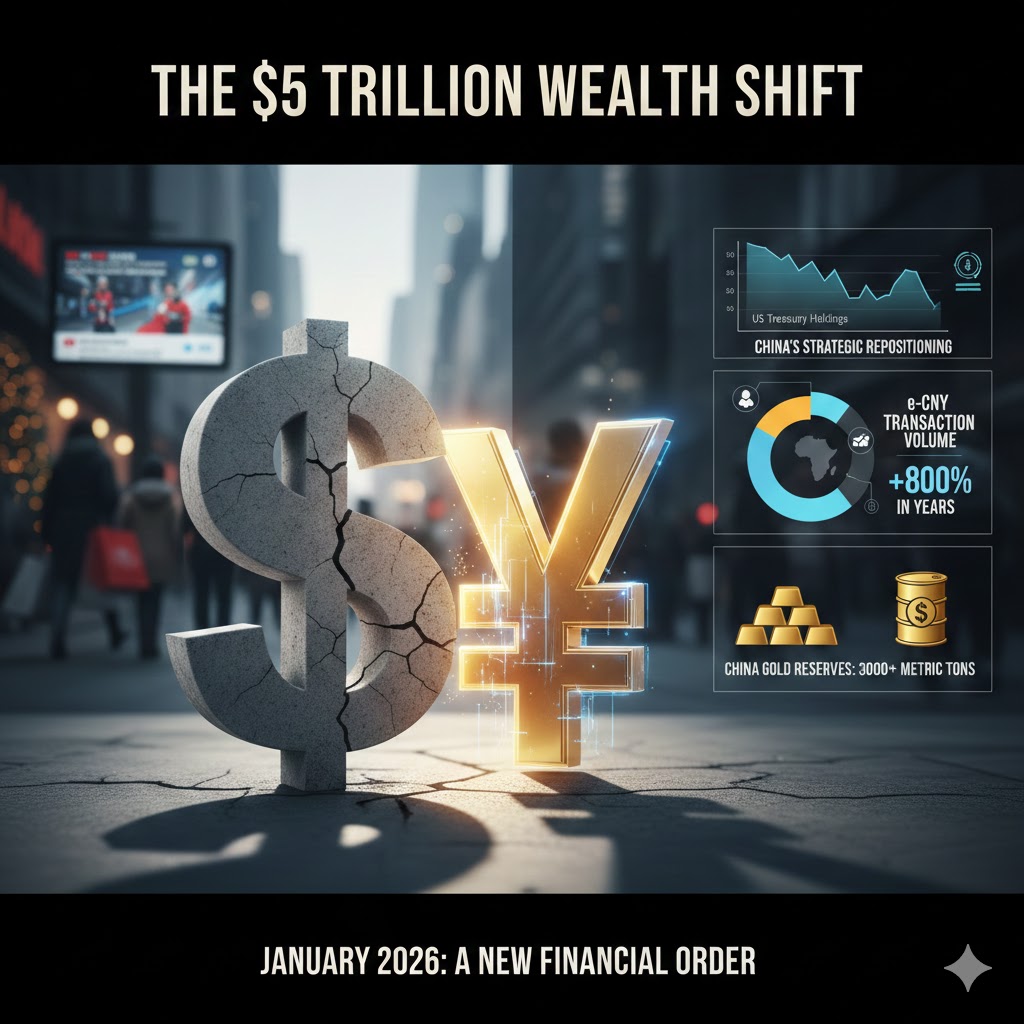
Since its rollout, adoption has accelerated rapidly. By the end of 2025, transaction volumes crossed $2.3 trillion, growing nearly 800% in just two years.
What makes the digital yuan different?
- Instant settlement
- No dependence on US banks
- No reliance on the SWIFT system
- Reduced exposure to sanctions
For countries frustrated by dollar dominance, this is not just convenient—it’s liberating.
Also Read; शून्य निवेश; बिजनेस आइडिया और निष्पादन रणनीति रणनीति
Why Global South Nations Are Paying Attention
Countries across Africa, Southeast Asia, Latin America, and the BRICS bloc have long faced vulnerabilities tied to dollar dependence.
US interest rate hikes.
Sanctions.
Liquidity shocks.
China is now offering an alternative.
Trade between China and Africa alone surpassed $400 billion, with a growing share settled in yuan or local currencies. Similar patterns are emerging across Asia and the Middle East.
This is not ideology.
It’s pragmatism.
Commodities as a Financial Weapon
China’s strategy goes far beyond currency.
In early 2026, Beijing tightened control over silver exports, triggering volatility across global commodity markets. Silver is not just a precious metal—it’s critical for:
- Electronics
- Solar energy
- Industrial manufacturing
China also controls over 70% of rare earth refining capacity, giving it leverage over supply chains essential to modern technology and defense systems.
When supply tightens, prices surge—and financial stress spreads quickly across markets.
The Petro-Dollar Under Pressure
For decades, oil pricing in dollars ensured constant global demand for US currency. This system—the petro-dollar—was the cornerstone of American financial dominance.
That foundation is now cracking.
China has signed agreements with major energy exporters to settle oil trades in yuan. Russia and Iran have already moved away from dollar pricing. Even traditionally aligned economies are quietly diversifying.
The Dollar’s Growing Trust Deficit
When energy no longer requires dollars, demand weakens—and value follows.
Also Read; How Insurance Companies Make Money in India?
The US dollar’s power depends on confidence. But that confidence is eroding.
- US national debt has crossed $36 trillion
- Interest payments are approaching $900 billion annually
- The Federal Reserve’s balance sheet has expanded tenfold since 2008
Foreign holders of US Treasuries are reducing exposure. China’s holdings are at their lowest level in 14 years. Japan is following the same path.
This is not panic selling.
It’s strategic repositioning.
Gold, Blockchain, and Long-Term Strategy
China has also quietly expanded its gold reserves, exceeding 3,000 metric tons by late 2025. At the same time, it is investing heavily in blockchain-based trade infrastructure.
The goal is clear: build a parallel financial system—one that does not depend on the dollar for trust, liquidity, or settlement.
What This Means for Ordinary People
This wealth shift is not abstract. It has real-world consequences:
- Higher import prices
- Rising inflation
- Increased interest rates
- Reduced purchasing power
- Slower economic growth
For decades, dollar dominance allowed the US to borrow cheaply and spend freely. That privilege is not guaranteed forever.
A Turning Point in Global Finance
The $5 trillion wealth shift is not a single event. It is the culmination of years of planning, coordination, and long-term vision.
China is not reacting to the system.
It is redesigning it.
Whether this leads to a multipolar currency world or a new financial order altogether remains uncertain. But one thing is clear:
The era of unquestioned dollar dominance is being challenged—quietly, strategically, and relentlessly.
History rarely announces itself loudly.
It moves in silence—until the consequences become unavoidable.


