
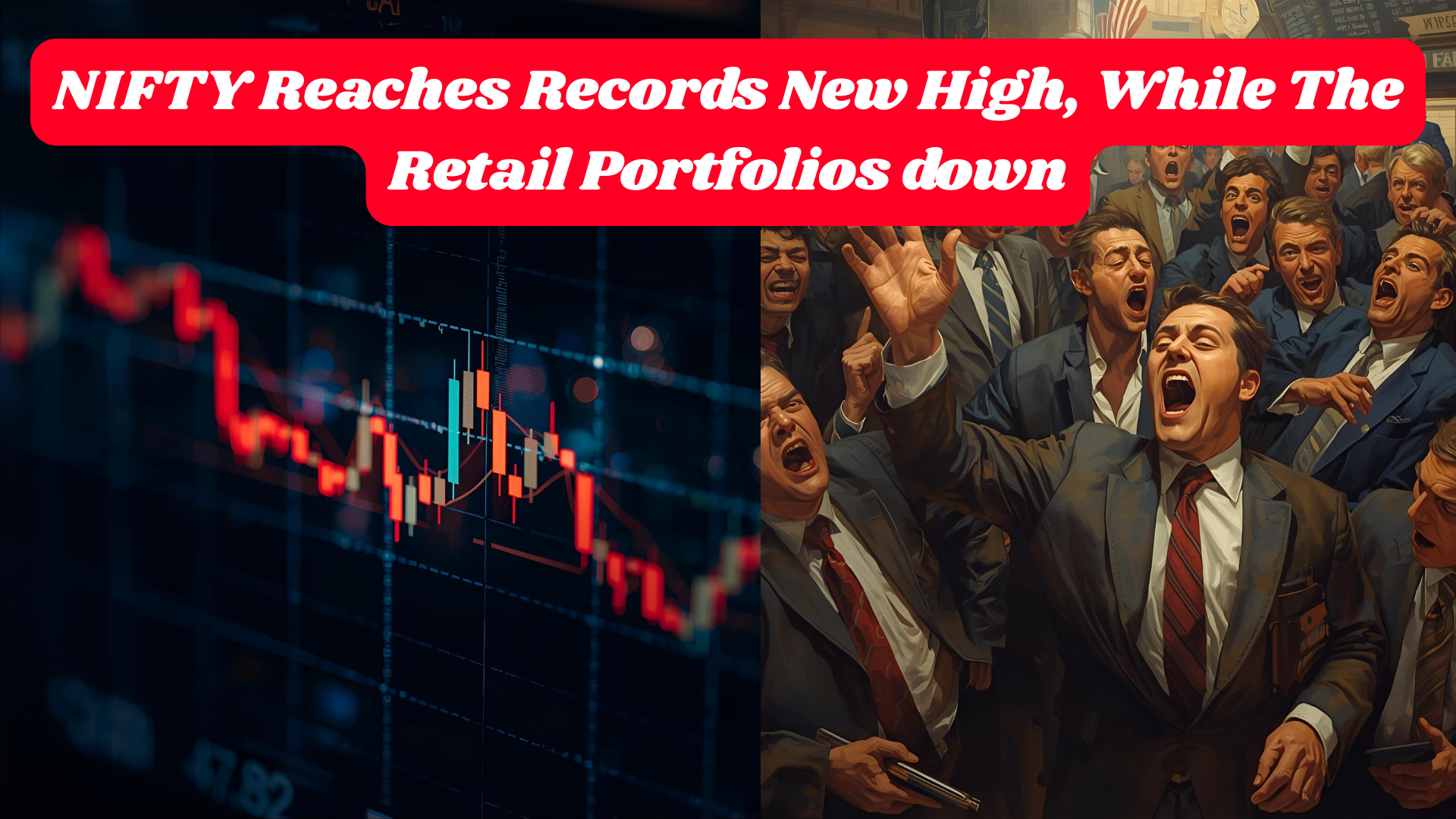

NIFTY Reaches Records New High, While The Retail Portfolios down
In the world of investing, there’s a phenomenon that can be both confusing and frustrating: watching a headline index like the NIFTY 50 touch a new all-time high while your personal investment portfolio remains deep in the red. If you’re a retail investor experiencing this, you are not alone. This “Great Market Disconnect” is a common occurrence and reveals a deeper truth about market movements.
The Narrow Rally: Not All Stocks Are Created Equal
The NIFTY 50 is a benchmark index composed of 50 of the largest and most liquid Indian stocks. Its performance is heavily influenced by a handful of these large-cap behemoths. When these specific stocks perform exceptionally well, they can single-handedly drive the index upward, masking the poor performance of other stocks.
Also Read; Why Rare Earth Elements Are the New Oil for World? –
For example, even as the NIFTY soared to record levels recently, reports show that a significant number of NIFTY stocks were still trading below their previous all-time highs. Meanwhile, sectors like banking, manufacturing, and defense have seen strong inflows, but this rally has not trickled down to all parts of the market. NIFTY Reaches Records New High, While The Retail Portfolios down
The Pain in the Broader Market: The Small-Cap and Mid-Cap Carnage
The most significant factor for many retail investors is their exposure to the broader market, which includes small-cap and mid-cap stocks. Historically, these segments have been where many retail investors focus their investments. Unfortunately, during recent concentrated rallies, these segments have significantly underperformed the large-cap-dominated NIFTY 50.
The result is a weak “market breadth,” a situation where the index looks strong, but the majority of stocks are not participating in the rally. Your portfolio, filled with these underperforming small- and mid-caps, reflects this underlying weakness, even as the NIFTY’s overall number suggests a booming market.
Also Read; शून्य निवेश; बिजनेस आइडिया और निष्पादन रणनीति रणनीति
The Behavioral Trap: Why Timing the Market Fails
Retail investors often get caught in behavioral traps, including trying to time the market by buying or selling based on emotion. When the NIFTY is at a new high, there’s a fear of missing out, or “FOMO,” which can lead to investing without proper research. Conversely, a falling portfolio can cause panic selling, locking in losses.
Successful investing, as history shows, is more about “time in the market” than “timing the market”. Disciplined investing through SIPs (Systematic Investment Plans) and sticking to a long-term strategy often yields better results.
How to Navigate This Disconnect: A Plan for Retail Investors
- Check Your Diversification: Look at your portfolio’s composition. Is it overly concentrated in a few mid- or small-cap stocks? Consider diversifying across market capitalizations and sectors to reduce risk.
- Focus on Quality, Not Hype: Instead of chasing hot stock tips, focus on fundamentally strong companies with a clear growth trajectory, regardless of market conditions.
- Manage Your Risk: Avoid over-leveraging and only invest capital you can afford to lose. Implement a risk management strategy, such as setting stop-loss orders.
- Embrace Disciplined Investing: Continue with your SIPs or staggered investments to benefit from rupee-cost averaging and long-term compounding.
- Educate Yourself: Rely on credible sources for analysis and learn to interpret market movements beyond the headline indices. Understand that a bull market in the NIFTY doesn’t guarantee gains for all stocks.
NIFTY Reaches Records New High, While The Retail Portfolios
The next time you see the NIFTY at a record high while your portfolio struggles, remember that the index is not your portfolio. By understanding the underlying market dynamics and adopting a disciplined, diversified, and risk-managed approach, you can navigate this complex market landscape more effectively. NIFTY Reaches Records New High, While The Retail Portfolios down